
NEWS
“Just Hours After Deadly 7.4 Earthquake Kills Over 100 in Colombia, New Government Drops Bombshell: Official Recognition of Israel’s Sovereignty Over the Golan Heights”

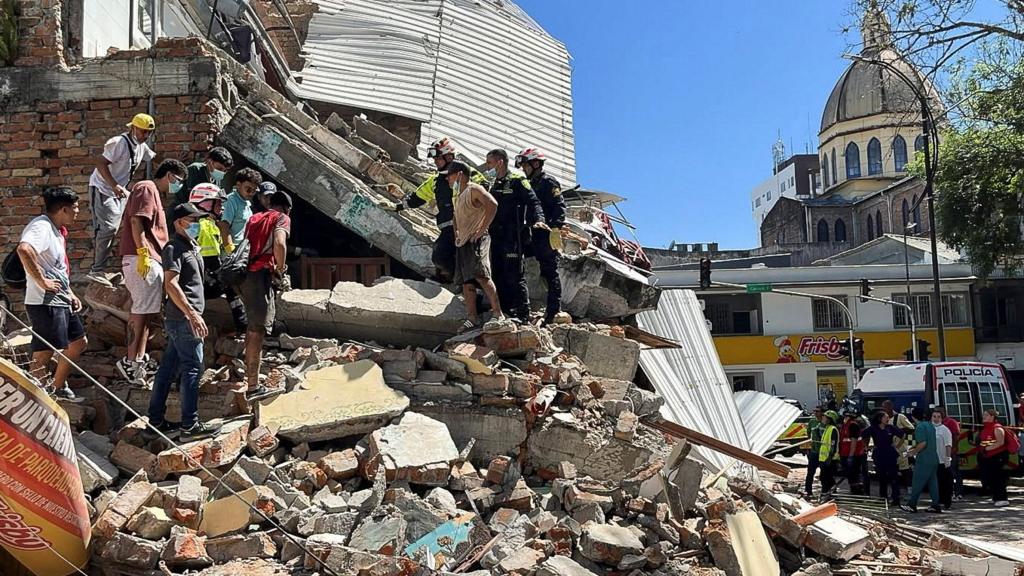
Bogotá — As rescue teams scrambled through the rubble of collapsed buildings and families searched for missing loved ones, Colombia’s newly installed government issued a major foreign policy announcement that immediately drew sharp criticism for its timing.On Monday morning, August 10, 2026, a powerful magnitude 7.4 earthquake struck western Colombia at 7:34 a.m. local time.
The quake, centered near San José del Palmar in the sparsely populated Chocó department at a depth of roughly 100–110 kilometers, was felt across much of the country and in neighboring nations. Officials reported at least 111 people killed and more than 460 injured. Significant damage and fatalities were concentrated in the coffee-growing region, including Pereira, where dozens died and part of the Matecaña International Airport partially collapsed, as well as in Manizales, Cali, and other cities.
The government declared a national emergency as airports closed, buildings toppled, and emergency crews worked to free people trapped under debris.Less than three hours after the initial reports of the disaster began circulating widely, the Colombian Foreign Ministry released a statement recognizing Israel’s sovereignty over the Golan Heights.
The announcement, posted on the ministry’s official channels in the early afternoon, declared that “given the persistent regional instability in the Middle East and considering the strategic importance of the Golan Heights to Israel’s security, the Government of Colombia recognizes Israeli sovereignty over this territory, as well as the right of that state to protect itself against external threats.”The statement framed the decision as essential to Israel’s national defense and noted that it fulfilled a commitment reached between the two countries on August 8. Colombia becomes only the second nation after the United States to formally recognize Israeli sovereignty over the territory, which Israel captured from Syria in the 1967 Six-Day War and effectively annexed in 1981—a move long rejected by most of the international community.
The announcement came under the administration of President Abelardo de la Espriella, who took office just days earlier. The new government’s rapid move on the Golan issue marks a clear shift in Colombia’s foreign policy orientation.Former Bogotá mayor and current senator Claudia López Hernández was among the first prominent voices to condemn the timing. Quoting the Foreign Ministry’s post, she wrote: “Three hours after the earthquake occurred, in the middle of such a national tragedy and this is the priority of the Foreign Ministry of the new government??? What infinite disconnection! First Colombia! Our people, attention to the victims. A minimum of logical sense and humanity!”Her criticism quickly gained traction on social media, capturing a broader sense of frustration among some Colombians who felt the government should have focused exclusively on the domestic emergency. While rescue operations continued and the death toll was still being updated, the dual news of national tragedy and a high-profile diplomatic decision created a striking contrast that dominated political discussion throughout the day.
The earthquake remains the immediate priority for emergency services, with officials emphasizing the need to locate survivors and assess structural damage across multiple regions. At the same time, the Golan Heights recognition signals the new administration’s intent to realign Colombia’s international posture early in its term—regardless of the domestic crisis unfolding at home.

Anonymous Celebrity May Die by Suicide if Sex Misconduct Claims Go Public, Lawyers Say

“WHO KNEW THEY’D LOOK THIS GOOD TOGETHER?” Mary J. Blige and Alex Adams Spark a Buzz as Fans React to Their Unexpected Pairing

JUST IN: Tom Brady, 49, Spotted Hugging and Kissing 38-Year-Old Supermodel Candice Swanepoel on His $22.5 Million Mega Yacht! But What Happened Next Between Them in Miami Has Fans Asking ONE Big Question!

CAUGHT ON CAMERA IN FRANCE! Ferran Torres and Sydney Sweeney Spark MAJOR BUZZ With Intimate Boat Moments — Their Unexpected Chemistry Has Everyone Talking!

Connor Storrie in Talks to Join Ryan Gosling in Marvel’s ‘Ghost Rider’

Taylor Swift Officially Releases an Exclusive First Look at Her Wedding Photos With Travis Kelce After Months of Secrecy and Recent Daily Mail Leak of the Original Layout Plans and Scrapped Decisions

“So disgusting”: Taylor Swift, POP STAR and Travis Kelce beach image sparks heated fan war and viral body image debate across all social media

After the Long Wait, Taylor Swift Finally Reveals 7 Never-Before-Seen Photos and 1 Video From Her Star-Studded MSG Wedding to Travis Kelce! Fans Can’t Stop Rewatching the Video ⤵️

Taylor Swift and Travis Kelce’s extravagant wedding décor was burned to the ground immediately after $30M ceremony: report

U.K. Police Misplaced Letter Accusing Meghan Markle’s Dad of Child Sex Offenses, Then Asked Her for Copy: Report

Tyler Perry was captured getting a kiss from his new boyfriend during a yacht trip, but he immediately stopped when he noticed someone taking pictures of them.
